

|
Waves on the ocean: unity in the absolute
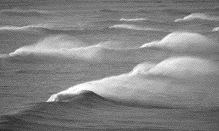 |
But how exactly can we say that all things are one? We can use waves on the ocean as a metaphor for the idea of everything and nothing at once, since they are both ephemeral and part of a larger reality, the sea, out of which they emerge, assume a physical appearance, and then dissolve. They seem to exist, yet you cannot grasp and hold them. They are both existing and nonexistent. Thus they resemble the Void, a kind of energy that manifests itself through diverse illusory objects of the senses, but which is itself ungraspable, changeless unity. With this in mind, perhaps it is easier to understand Baizhang when he declares:
The nature of the Absolute is void and yet not void. How so? The marvelous "substance" of the Absolute, having neither form nor shape, is therefore undiscoverable; hence it is void. Nevertheless, that immaterial, formless "substance" contains functions as numerous as the sands of the Ganges, functions which respond unfailingly to circumstances, so it is also described as not void.
By focusing on this idea of unity in an Absolute, we also interact with our own perception of time. Since it is important that the mind not dwell on anything, naturally enough this applies to time as well as space.
If you want to understand the non-dwelling mind very clearly, while you are actually sitting in meditation, you must be cognizant only of the mind Whatever is past is past, so do not sit in judgment upon it; for when minding about the past ceases of itself, it can be said that there is no longer any past. Whatever is in the future is not here yet, so do not direct your hopes and longings towards it; for, when minding about the future ceases of itself, it can be said that there is no future. Whatever is present is now at hand; just be conscious of your non-attachment to everything—non-attachment in the sense of not allowing any love or aversion for anything to enter your mind; for, when minding the present ceases of itself, we may say that there is no present.
Baizhang took the idea of the "now" to an interesting new dimension. By cutting off thoughts of past and future, you not only save yourself mental anguish, you also no longer need distinguish the idea of the "present." And you have just eliminated a major aspect of attachment.
 |
 |