

|
Hanshan
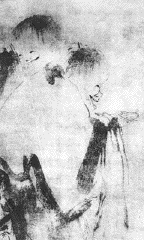 |
Hanshan and his companion Shihte |
An even more elusive figure is the hermit Hanshan, whose name means "Cold Mountain," the site where he supposedly resided. He is an almost totally legendary character, for we actually know nothing for sure about when he lived (the current best guess is late eighth to early ninth century). Almost everything known about him has been gleaned from his poems and from a presumably contemporaneous preface to these poems composed by a mysterious hand untraceable to any historical Chinese individual. His was some of the most confessional, yet joyous, verse penned in Tang China, and he has been claimed by the Chanists as one of theirs, although he might just as easily have been a Taoist conversant in Buddhist jargon.
Hanshan embodied the archetypal hero of the Chinese imagination: a member of the rural gentry who gave up his staid family life and some sort of scholarly career to become a wandering poet. We will not pursue the fanciful story that has come down regarding his life. However, by the time Hanshan was thirty he found himself on Cold Mountain in Tientai mountains.
Thirty years ago I was born into the world.
A thousand, ten thousand miles I've roamed.
By rivers where the green grass lies thick,
Beyond the border where the red sands fly.
I brewed potions in a vain search for life everlasting.
I read books, I sang songs of history,
And today I've come home to Cold Mountain
To pillow my head on the stream and wash my ears.
He described his life in the mountains in a number of verses that often seem more Taoist than Buddhist. This is one of the most lyrical:
Ever since the time when I hid in the Cold Mountain
I have kept alive by eating the mountain-fruits.
From day to day what is there to trouble me?
This my life follows a destined course.
The days and months flow ceaseless as a stream;
Our time is brief as the flash struck on a stone.
If Heaven and Earth shift, then let them shift;
I shall still be sitting happy among the rocks.
Hanshan does seem to have been Buddhist in outlook, and as one of his translators, Burton Watson, has said, ". . . to judge from his poetry, Hanshan was a follower of the Chan sect, which placed great emphasis on individual effort and was less wary of emotionalism than earlier Buddhism had been .... Though he writes at times in a mood of serenity, at other times he appears despondent, angry, arrogant, or wildly elated."
As did Layman Pang, Hanshan seems to have believed that the Way is found in everyday-mindedness, a point of view most forcefully expounded by Mazu. As Hanshan declares in one of his poems:
As for me, I delight in the everyday Way,
Among mist-wrapped vines and rocky caves.
Here in the wilderness I am completely free,
With my friends, the white clouds, idling forever.
There are roads, but they do not reach the world;
Since I am mindless, who can rouse my thoughts?
On a bed of stone I sit, alone in the night,
While the round moon climbs up Cold Mountain.
Many of his verses reinforce the belief that he was indeed a follower of Southern Chan. For example, he seemed to believe that the mind itself is the Buddha that all seek.
Talking about food won't make you full,
Babbling of clothes won't keep out the cold.
A bowl of rice is what fills the belly;
It takes a suit of clothing to make you warm.
And yet, without stopping to consider this.
You complain that Buddha is hard to find.
Turn your mind within! There he is!
Why look for him abroad?
Interestingly enough, for all his rather traditional Chan sentiments and admonitions, he was much more in touch with human concerns than were most followers of Chan. For one thing, he lived alone in the mountains, an isolated ascetic cut off from human contact, and the resulting loneliness was something those caught up in the riotous give-and-take of a Chan monastery never knew. Here he gives voice to this loneliness:.
I look far off at Tientai's summit,
Alone and high above the crowding peaks–
Pines and bamboos sing in the wind that sways them;
Sea tides wash beneath the shining moon.
I gaze at the mountain's green borders below
And discuss philosophy with the white clouds.
In the wilderness, mountains and seas are all right,
But I wish I had a companion in.my search for the Way.
 |
 |