

|
Collecting the koans
By the middle of the tenth century, people were assembling collections of 'old cases,' as the koans were sometimes called, as well systematizing them—for example, putting the koans into a fixed form. As well, a few masters were offering their own alternate answers to some of the old koans and occasionally appending verses to them. In many cases these alternate answers and verses ultimately became attached to the original koans and were handled as koans supplementary to them.''
Ironically, koans became so useful—indeed essential—in the perpetuation of Chan that they soon were revered as texts. Collections of the better koans appeared, and next came accretions of supporting commentaries—when the whole point was supposed to be circumventing reliance on words! But commentaries always seemed to develop spontaneously out of Chan.
Today two major collections of koans are generally used by students of Zen. These are the Mumonkan (it's familiar Japanese name, Wu Men Guan in Chinese) and the Hekiganroku (Pi Yen Lu in Chinese) or Blue Cliff Record.
The Blue Cliff Record
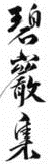 |
The Blue Cliff Record was the first of the two collections. It began as a grouping of one hundred kungan by a master named Xuetou Chongxian (Hsueh-tou Ch'ung-hsien) (980-1052) of the school of' Yunmen. He also attached a small poem to each koan, intended to direct the student toward its meaning. The book enjoyed sizable circulation throughout the latter part of the eleventh century. Sometime thereafter a Linji master named Yuanwu Keqin (Yuan-wu K'o-ch'in) (1063-1135) decided to embellish it by adding an introduction to each koan and a long-winded commentary on both the koan and the poem supplied by the previous collector. Masters today often omit Yuanwu's commentaries, giving their own interpretation instead The commentator, Yuanwu, was the teacher of Dahui, the dynamic master of the Linji lineage whom we will meet in the next lesson.
 |
The Mumonkan
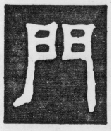
The Mumonkan, a shorter work, was assembled in 1228 by the Chan monk Wumen Huikai (Wu-men Hui-k'ai) (1183-1260) and consists of forty-eight kungan, together with an explanatory comment and a verse. Some of the kungan in the Mumonkan also appear in the Blue Cliff Record. The Mumonkan's koans are briefer and less challenging than the Blue Cliff Record's. Wumen's preface includes the following:
Our teaching makes our mind the principle and the gateless gate its very gate. Since it is the gateless gate, how can one pass through it?
Are you not aware of the insight that purports,"Those who have entered the gate are no family treasures. What is gained as a result of cause and effect has beginning and end, and thus will become nothing." Such remarks are like raising up waves in the windless ocean, or gouging a wound into healthy skin. Those who cling onto words are fools who believe that they can catch the moon with a stick or can scratch their itchy foot through a leather shoe. How can they "see" reality as it actually is?
Verse
The Great Way has no gate,
A thousand roads enter it.
When one passes through this gateless gate,
He freely walks between heaven and earth.
 |
 |