

|
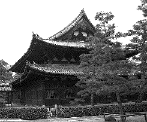 |
Daito founded the Zen monastery Daitoku-ji in Kyoto. We'll see that Ikkyu (Lesson 30) would trace his lineage to Daito and Daio and on back to Rinzai (Linji), and as an old man he would agree to rebuild Daitoku-ji.
Like Daio, Daito was willing to work with the political elite and became a national teacher. Along with his successor Kanzan Egen, these three created Japanese Rinzai Zen as we know it.

As we'll see in the next lesson, the great Soto Zen master Dogen learned the basic of Rinzai Zen at Eisai's temple, studying under Eisai's disciple, Myozen. Dogen may have been impressed as much by the legend of Eisai as by the shouting and beating of the Rinzai sect, for he often sprinkled stories about Eisai through his writings, and sermons thereafter.
It may seem ironic that Rinzai Zen, which began in China as a school of meditation and then became an iconoclastic movement using koans to beat down the analytical faculties, finally emerged (in an amalgam with other teachings) in Japan as a psychological mainstay for the soldiers of a military dictatorship. Rinzai Zen provided them with an avenue to Chinese culture, bypassing the court-dominated Tendai and Shingon sects. At the same time, its style—direct, one-on-one, forcing the student to be quick on his feet—appealed to their warrior spirit.
There was, however, another Japanese school of Zen that introduced its practice in a form more closely resembling original Chan. This was the movement started by Dogen, who we explore in the next lesson. In later lessons we return to the Rinzai school and its influential masters Ikkyu and Hakuin.
 |
 |