

|
The lineage of ancestors
It is said that from Shakyamuni the essence of the Buddha's Enlightenment was transmitted through twenty-eight generations of Indian Dhyana (meditation) masters to Bodhidharma in the sixth century. Because direct transmission is an essential component of Zen, many have felt a need to define a direct line of transmission from today's masters back to Shakyamuni Buddha. Others question the historical accuracy of such a line of transmission.
We propose that it is possible to believe that Zen has been transmitted directly from teacher to student while acknowledging that we may not have historical records to document each link in the chain. To acknowledge that, for example, Nagarjuna may have been designated the fourteenth patriarch long after he lived in no way dilutes the power of the transmission.
Nagarjuna
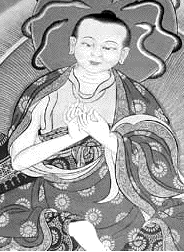 |
Of the many Buddhist figures who lived between the Buddha and the advent of Zen, we will mention but one. The second-century Indian philosopher Nagarjuna is for many the second most important Buddhist figure after the Buddha.
Nagarjuna taught the Middle Path, so named because it strove to define a middle ground between affirmation of the world and complete negation of existence. Reality, said Nagarjuna, cannot be realized through conceptual constructions, since concepts are contained inside reality, not vice versa. Consequently, only through the intuitive mind can reality be approached. His name for this "reality" beyond the mind's analysis was sunyata, usually translated as "emptiness" but sometimes as boundlessness or "the Void."
Nagarjuna's most-quoted manifesto has the logic-defying ring of a Zen koan:
Nothing comes into existence nor does anything disappear. Nothing is eternal, nor has anything any end. Nothing is identical or differentiated. Nothing moves hither and thither.
As the Chan teachers interpreted the teaching of sunyata, the things of this world are all a mental creation, since external phenomena are transient, and only exist for us because of our perception. Consequently they are actually "created" by our mind (in fact, by a more universal entity called Mind). Consequently, they do not exist outside our mind and hence are void. Yet the mind itself, which is the only thing real, is also a void since its thoughts cannot be located by the five senses. The Void is therefore everything, since it includes both the world and the mind. Hence, sunyata.
The Zen masters found ways to achieve the cognition without attachment
postulated by Nagarjuna, and they paid him homage by making him one
of the legendary twenty-eight Indian Patriarchs of Zen by posthumous
decree.
 |
 |