

|
Buddhism comes to China: the origins of Chan
|

The story of Chan usually begins with the arrival of Bodhidharma, a meditation (Dhyana) master from India, in China around 520. It was his arrival that marked the beginning of Chan.
Buddhism, however, had been part of Chinese culture for several hundred years before Bodhidharma‘s arrival.
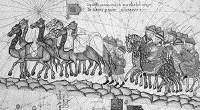 |
As Central Asian merchants settled in major Chinese cities, they set up monasteries in their enclaves and brought monks to staff them. With the arrival of monks, texts began being translated, temples were built, and many schools of Buddhism flourished.
By the time Buddhism traveled to China there were in India a profusion of schools and sects, with a huge number of texts (scriptures) and commentaries. Just as is the case in the West today, “Buddhism” did nor arrive in China as some unified coherent system but rather as a torrent of exotic and foreign religious wisdom and practices from many schools and perspectives.
While Buddhism at first was not welcomed by a society with its own
ancient literary and religious traditions, one founded on Confucianism
and Taoism, the decline and dissipation of the Han dynasty led to a
crisis of values which led many to question Confucianism. In this climate,
Buddhism’s emphasis on the equality of all (we all have Buddha nature),
skillful means, and the powers of its meditation systems
appealed to many.
By the time Bodhidharma arrived in China in the sixth century, Buddhism
had made an enormous impact on Chinese life. By the sixth century China
had hundreds of Buddhist temples, a monastic population of many thousands,
and fervent lay devotees ranging from the emperor down to humble peasants.
Buddhism may, in fact, have been confused with Taoism at first. Language was a major obstacle to the transmission of the Buddhist teachings, as Sanskrit was significantly different than Chinese in syntax and sensibility. Consequently many Buddhist concepts were at first understood and explained in the conceptual language of the Chinese, primarily Taoism.
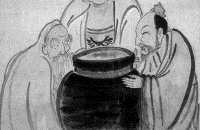 |
Buddha and
Laozi by Hakuin |
Rather than try to introduce the new ideas in Buddhist metaphysics, early Buddhist missionaries tried to gain acceptability for Buddhism by explaining it in Taoist terms, including stretching the two enough to find "matching concepts" or ideas with superficial similarity, and they also let out the myth that the Buddha was actually Laozi (Lao Tzu), who had gone on to India after leaving China. As well, Buddhism was presented to the masses in an overly simple form, dwelling on magic and ritual.
As well, there were aspects of Buddhism that rubbed the Chinese the wrong way. There were practical matters: Buddhism allowed, if not encouraged, begging, celibacy, and neglect of ancestors, all practices to rankle any traditional Chinese. Then there were fundamental philosophical differences: Buddhism offered to break one out of the Hindu cycle of rebirth, something the Chinese had not realized they needed; and Indian thought was naturally geared to cosmic time, with its endless cycles of eons, whereas the Chinese saw time as a line leading back to identifiable ancestors.
 |
 |