

|
Basho
 |
We conclude with Matsuo Basho (1644-1694), a poet who lived a century before Ryokan and who is primarily responsible for the evolution of the 17-syllable haiku from earlier forms of waka and renga poetry to a genre whose popularity continues today both in the East and the West.
Basho's attention to the natural world and the inner world transformed this verse form from a frivolous social pastime into a major genre of Japanese poetry. As was true of earlier forms of poetry, haiku itself is not "Zen poetry". Nevertheless, Zen has had an enormous influence on the writing of haiku, and in the hands of a poet like Basho it became a form that expressed the Way that we have been exploring in this course. Later Zen poets such as Ryokan took up this form of verse.
We will not pursue Basho's life story in any detail. The details of Basho's early life are in question, but it is thought that in his 20s he trained as a Buddhist monk and studied Japanese and Chinese classics and calligraphy. Although he did not remain a monk, he did continue Zen practice with his teacher Buchho while beginning his career as a poet. After many years in the city Basho moved to his basho-an, a hut made of plantain (basho) leaves and the source of his pseudonym.
Poet pilgrim
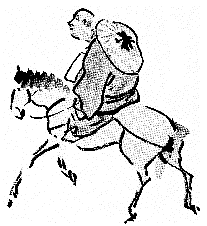
In the last ten years of his life Basho made several long walking journeys, reporting on them in a series of books and drawing from them more images to inspire his contemplative poetry. On these journeys, Basho wore the black robes of the Buddhist monk. At the beginning of one book Basho wrote:
Following the example of the ancient priest who is said to have traveled thousands of miles caring naught for his provisions and attaining the state of sheer ecstasy under the pure beams of the moon, I left my house on the River Sumida in the August of the first year of Jyokyo among the wails of the Autumn wind.
 |
In this stage of his life when Basho became the poet pilgrim, his writings evince the unity of the journey and Zen practice. Narrow Road to the Interior is a long meditation on the ecstasy and the sorrow of each moment of awareness, The Knapsack Notebook an exploration of the fusion of pilgrimage and poetry, and Travelogue of Weather-Beaten Bones a record of Basho's pilgrimage on the path of his spiritual and poetic master, Saigyo.
All along this road
not a single soul—only
autumn evening
This "road" is at once the road of poetry, the road of Zen practice, and the road of life itself. All of these are one for Basho. So it was through his lifelong development of the Way of Poetry. In the autumn of his life Basho concerned himself with this road without a single soul; not only do we travel this road alone, but even the status of our own self ultimately has no meaning when confronted with the lonely depths of an autumn evening.
People's poet
Basho was a poet of the people's poet. Unlike the poetry of the aristocracy with its rarified language, Basho's haiku focused on everyday experience using everyday language. It was direct, sharp and stimulating in its connection with the concrete reality of nature and existence.
What is important is to keep our mind high in the world of true understanding, and, returning to the world of our daily experience, to seek therein the truth of beauty. No matter what we may be doing at a given moment, we must not forget that it has a bearing upon our everlasting self which is poetry.
The autumn full moon
All night long
I walked around the lake

First winter rain
The monkey also seems to wish for
A straw raincoat
 |
 |