

|
Essential nature and Self
 |
Zen masters have long said that to practice Zen is to become intimate with the Self. The Self is that expansive dimension to being often called essential nature. It includes and does not oppose the ego with which we normally identify ourselves and from which we create the 'persona' we present to others.
In learning intimacy with the Self, ego is transcended, its bondage is escaped, and it can be used freely, compassionately and wisely.
This relationship between ego and essential nature was illustrated by the Japanese Zen master Bankei (Lesson 31) with an analogy from needlework.
The unborn Buddha-mind deals freely and spontaneously with anything that presents itself to it. But if something should happen to make you change the Buddha-mind into thought, then you run into trouble and lose that freedom. Let me give you an example.
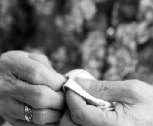 |
Suppose a woman is engaged in sewing something. A friend enters the room and begins speaking to her. As long as she both listens to her friend and sews in the Unborn, she has no trouble doing both. But if she gives her attention to her friend's words and a thought arises in her mind as she thinks about what to reply, her hands stop sewing; if she turns her attention to her sewing and thinks about that, she fails to catch everything her friend is saying, and the conversation does not proceed smoothly. In either case, her Buddha-mind has slipped from the place of the Unborn. She has transformed it into thought. As her thoughts fix upon one thing, they're blank to all others, depriving her mind of its freedom.
Bankei
If the unborn Buddha-mind is the true nature of our ordinary minds then it must follow that it is to be found in the midst of our ordinary lives. In Zen training, intimacy with self confronts us with the world of everyday forms. This intimacy with the forms of the everyday world then confronts us with the reality of emptiness and impermanence. Dogen Zenji (Lesson 27) said:
To study the Buddha way is to study the self.
To study the self is to forget the self.
To forget oneself is to be actualized by myriad things.
When actualized by myriad things, your body and mind as well as the bodies and
minds of others drop away.
It is this falling off of one's body and mind that leads to the realization that there is no fixed entity commonly referred to as oneself, only boundless, infinite, unobstructed space. As Andy Ferguson points out regarding the teachings that you will discover in this course:
. . . concepts like "mind" and "realizing
self-nature" might
rightfully be dismissed as fanciful by anyone not familiar with the
astounding lives of the Zen ancients. The authentic ancient masters,
without exception, displayed certain quite remarkable characteristics.
Chief among these characteristics was an ineffable sense of total
freedom and ease, of peace and equanimity. Such repose is not a "learned" behavior.
It appears to be the natural result of truly shedding concern with
one's self. It seemed to arise from those ancients' realization of
the self's "empty" nature, that is, that the self is not
an independent, sovereign entity. The ancients would say, however,
that simply realizing genuine self-nature is not enough. The realization
must be upheld and sustained with long practice if it is to avoid
becoming a mere intellectual understanding. 
 |
 |