

|
Zen and meditation
 |
The word Zen itself is an abbreviation of Zenna or Zenno, which is the way the Japanese read the Chinese characters for Chan, and Chan is itself the Chinese transliteration of dhyana. Dhyana is a Sanskrit word that describes both the act of meditation and the state of non-dualistic consciousness (or other states of consciousness beyond that of ordinary experience) that may arise from its practice.
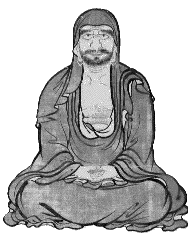
As one would suspect from the origins of the name Zen, Zazen (literally "seated meditation" in Japanese) is one foundation of Zen practice, the aim of which is to lead the practitioner to a full realization of his or her true nature. While you will often see it equated with Zen, meditation is rather a practice or discipline on the path to realization—"seeing things as they are."
While Zen is today often equated with meditation, in this course you will see that meditation has not always been viewed as an essential part of Zen practice and the quest for enlightenment. While Dogen, originator of the Soto school of Zen, chanced to study in China with perhaps the last remaining proponent of intense meditation and brought to Japan a fervent advocacy of zazen meditation, others masters such as Mazu viewed meditation as potentially harmful, yet another subtle form of attachment.
As we will also see, "meditation" or dhyana encompasses a wide range of practices rather than just the sitting practice we are accustomed to today.
Zen and enlightenment
|
All the Zen masters we will hear about and hear from in this course devoted their lives to attaining enlightenment and then helping others on their quest. So let us briefly explore "What is enlightenment?"
How are we to understand by words an experience we do not know? If anything, the words just get in the way. They may become concepts or preconceptions that we try to force out experience to fit. For this reason many of the great teachers of Buddhism have assiduously avoided describing enlightenment in terms around which preconceptions can be formed.
The contribution of Zen teachings has been to leave aside the dialectics of what enlightenment is or is not and to present its concrete manifestation in everyday life. Thus the way to practice Zen is not to form some conceptual understanding of what a teacher or text means by "essential nature" and then go looking for it. Instead it is to become aware of ourselves as we really are and to appreciate what it means to be consciously self-aware.
 |
 |
See the Ashoka course Zen Meditation: Entering the Path for an introduction to zazen meditation.