

|
Expedient means
The Buddha's response to the woman whose child had died is an example of the skillful methods he adopted to lead people to abandon their attachment to the discriminating mind—which he saw as the source of their troubles. He explained why he had to do this in the parable of the burning house:
The burning house
One day a fire broke out in the house of an elder while several children were inside. Although the man begged them to come out, the children were engrossed in play, and though it seemed certain they would be burned, they took no notice of the elder.
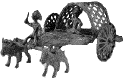 |
Realizing that he could not rescue them all from the quickly spreading flames, he remembered that the children all loved play things and desired toy carts, and so he called out to them to come out at once because he had the goat carts, deer carts and bullock carts that they were always wanting.
When the children heard this, they finally paid attention and rushed to get out. Thus they escaped from the burning house. When they were from harm and began asking for their carts, he gave to each of them not the ordinary carts they wanted, but carts splendidly decorated with precious things and drawn by great white bullocks.
As this is a parable, the symbolism is meant to be fairly obvious. The elder represents the Buddha, the burning house is the nature of existence which the Buddha called "Dukkha"—the world burning with the fires of old age, sickness and death. The children are humankind, and their play represents the mundane diversions with which we are all so busy that, even though we may be aware vaguely of the life of the true Self, we pay it no need. The goat, deer and bullock carts are the provisional teaching methods, in effect the "bait" by which the Buddha is able to make us listen and start to practice the Dharma, and the splendid carts pulled by the great white bullocks represent Enlightenment itself, to which the Buddha can only lead us once he has our cooperation and commitment.
The spirit of the entire history of the Buddha's Dharma is perhaps summarized in this story and it has been widely adapted and expanded upon.
The story also demonstrates the provisional nature of what the Buddha taught. He likened his teaching to a raft, useful so long as one is crossing the water, but to be left behind afterwards.
 |
In the Zen tradition the Buddha's teachings have been likened to a finger pointing at the moon. This metaphor helps guard against the mistake of thinking that being a Buddhist means believing in Buddhist teaching—that is, believing in the finger. As the metaphor implies, one is to see (and pay attention to) that to which the finger points.
In the Lankavatara Sutra the Buddha said:
If a man becomes attached to the literal meaning of words . . . in regard to the original state of Enlightenment which is unborn and undying . . . he will come to cherish views either affirmative or negative. As varieties of objects are seen in delusion, and are discriminated as real, statements are erroneously made, discriminations erroneously go on. It is by the ignorant that discriminations go on; it is otherwise by the wise.
Although the Dharma has been formulated into the Four Noble Truths, the Eightfold Path, the Five Spiritual Virtues, and Five Hindrances to Practice, the Twelve Links of Conditioned Existence and much more; these are all so many expedient means to bring people to understand the true nature of the human heart and mind.
 |
 |