

|
Transmission to Mahakashyapa
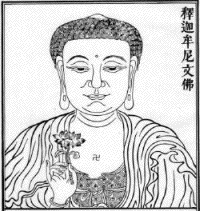 |
One day a large gathering awaited the Buddha's teachings. Instead of delivering a discourse, the Buddha sat silently. After a while he picked up a flower and held it in his hand for all to see. The disciples, it is said, were confused and unable to understand the Buddha's silence and his gesture. All except for Mahakashyapa, that is, who silently smiled at the Buddha. Seeing Mahakashyapa, the Buddha declared, "I have the most precious treasure, spiritual and transcendental, which this moment I hand over to you, venerable Mahakashyapa!"
Zen followers generally agree that this incident is the origin of their doctrine, for by raising the flower Shakyamuni symbolically revealed the innermost mind of the Buddha. The spirit of Zen is conveyed in what happened to Mahakashyapa, who, by letting the silence of the master penetrate the very core of his being, understood its deep significance. The master, is silent, the disciple smiles, the two minds are one.
Mahakashyapa had direct insight into the here-and-now experience of "just this flower", in the same way that Shakyamuni had experienced "just the morning star." And so the Zen tradition takes this incident—Shakyamuni symbolically revealing the innermost mind of the Buddha—as the origin of Zen.
This sudden understanding—this awakening through the penetration of the disciple by the teacher—is the model for the Zen experience, as we will see. And this experience encompasses what is core to Zen: Buddha nature inherent in everyone, direct pointing to the mind and one-to-one transmission, not dependent upon words.
 |
 |